TL;DR
A humanoid robot is a machine with a human-shaped body, built to work in spaces made for people. We read the product pages of seven makers on November 6, 2026: Boston Dynamics, Figure, Agility Robotics, 1X, Unitree, UBTech and Apptronik. Every figure is the maker's own claim, and the sheets do not measure the same things.
- Purpose: Makers say the robots work in spaces built for people, in warehouses, factories and homes.
- Parts: Boston Dynamics lists 56 degrees of freedom for Atlas, and Unitree lists 23 to 43 for the G1.
- Size: Unitree lists the G1 at about 35 kg, and Boston Dynamics lists Atlas at 90 kg.
- Status: As of November 6, 2026, 1X takes a $200 deposit for NEO, and Unitree lists the G1 from $13.5K.
- Limit: We did not test or measure any robot, so every number below is a claim by its maker.
What a humanoid robot is
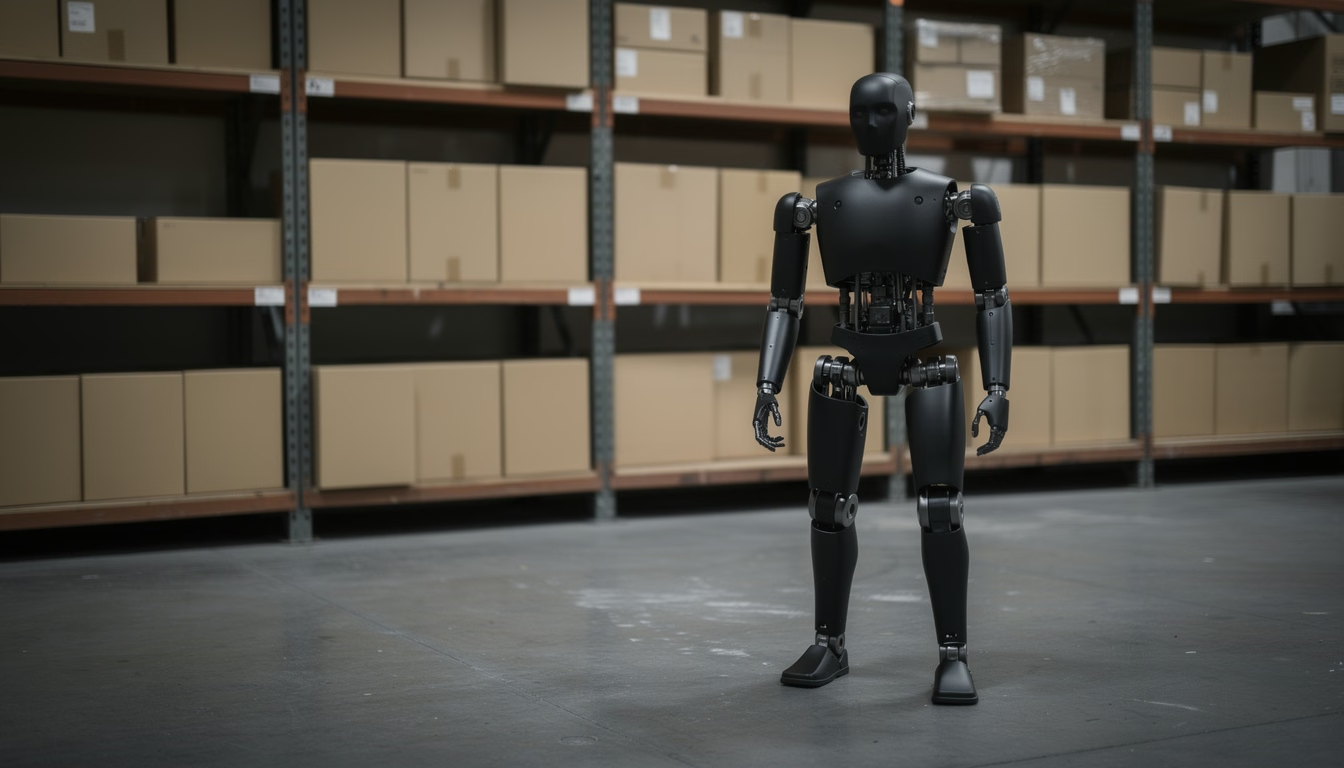
A humanoid robot has a body shaped like a person's. It stands on two legs, has two arms and uses hands.
Several makers give the same reason for the shape. Agility Robotics writes that “Digit’s human form factor means industrial environments don’t have to be redesigned.” Boston Dynamics writes that Atlas “is made to operate within the same workstations using the same equipment your staff does.”
These robots also run AI models. Figure calls its model Helix, a “vision-language-action AI”. 1X says NEO has a “built-in large language model”. What an LLM is: What Is an LLM? Large Language Models Explained
We retrieved the pages of seven makers on November 6, 2026. Tesla's page returned an access error, so Tesla is not covered.
How to read a humanoid spec sheet
Three terms appear on almost every sheet. Degrees of freedom count the independent ways a body can move. Payload is how much the robot can lift or carry. Battery life is how long it runs before it needs power.
Makers define these terms in their own way. Unitree adds a footnote to its G1 sheet: “The maximum load of the arm varies greatly under different arm extension postures.” Boston Dynamics lists “Weight Capacity (Instant)” at 50 kg and “Weight Capacity (Sustained)” at 30 kg for Atlas.
Boston Dynamics: Atlas
Boston Dynamics describes Atlas as “the world’s first enterprise-grade, industrial humanoid robot”. The page metadata shows a last change on October 19, 2026.
The page lists these figures: height 1.9 m, weight 90 kg, 56 degrees of freedom, reach 2.3 m and battery life 4 hours. It also lists an IP67 rating and an operating temperature of -20 to 40 degrees Celsius.
The robot changes its own battery. The page says: “Atlas autonomously navigates to a charging station and swaps out its own battery before getting right back on task.”
The first customer pilot is with Hyundai, for “field testing on real-world sequencing tasks”. The page also says: “We will be starting with a select number of early adopters”. It gives no price and no delivery date.
Figure: Figure 03
Figure introduced Figure 03 on October 9, 2025, as its “3rd generation humanoid robot”. The home page calls it “a general purpose humanoid robot for every day”.
The launch post lists several figures. Each fingertip sensor “can detect forces as small as three grams of pressure”. The robot charges wirelessly through coils in its feet at 2 kW. Figure 03 has 9% less mass than Figure 02. The post lists no height, weight, payload or run time.
On April 29, 2026, Figure reported “delivering over 350 of our third generation humanoid robots”. It also reported that the rate rose from 1 Figure 03 per day to 1 per hour.
The same post says where the robots go. They are allocated to “internal research and development groups, data collection, efforts for robots to perform end-to-end housework, and commercial use-case development”.
Agility Robotics: Digit
Agility Robotics builds Digit. Its solutions page lists four workflows: tote handling, palletizing and depalletizing, machine tending, and kitting and sequencing.
The page names five customers in statements by their staff, among them Amazon and Toyota Motor Manufacturing Canada. One reads: “After evaluating a number of robots, we are excited to deploy Digit to improve the team member experience and further increase operational efficiency in our manufacturing facilities.” (Tim Hollander, President, Toyota Motor Manufacturing Canada)
The page also shows a notice for the next model: “Digit 5 is in development and the features, specifications, capabilities, and designs shown are subject to change.” A direct Digit page returned 404, so we read only the solutions page. It lists no height, weight or payload.
1X: NEO
1X sells NEO as a home robot. The page offers a $200 deposit to order.
The hardware list gives these figures: height 5 ft 6 in, weight 66 lbs, lift 154 lbs, carry 55 lbs and arm payload 18 lbs. The battery holds 842 Wh with a run time of 4 hours.
On autonomy, the page is open about the limits. It says “NEO works autonomously by default”. It also says that NEO “arrives with basic autonomy for early owners” and grows over time.
For tasks NEO does not know, the page describes remote help: “an Expert from 1X can remotely supervise its actions at scheduled times to help it learn new abilities and get the job done.”
The page lists FAQ questions on deliveries and data use. The answers did not appear in the text we retrieved, so we report none.
Unitree: G1 and H1
Unitree lists the G1 with “Price from $13.5K”. The table gives US $13.5K and says tax and shipping are excluded.
The G1 stands 1320 mm tall. It weighs about 35 kg, has 23 degrees of freedom and runs about 2 hours on a charge. The arm load is about 2 kg. The G1 EDU model lists 23 to 43 degrees of freedom and about 3 kg of arm load.
The larger H1 is listed at about 180 cm and about 47 kg, with a moving speed of 3.3 m/s and a battery of 864 Wh.
Unitree states its own caveats. One note reads: “Some sample functions on this page are still being developed and tested, and will be opened to users in the future.” Another says “the global humanoid robot industry is in the early stages of exploration”.
UBTech and Apptronik
UBTech lists the Walker S2 as “The World's First Humanoid Robot Capable of Autonomous Battery Swapping”. The page says the robot can swap its battery within 3 minutes. The page gives no price. Its specification block says: “Please reach out for more request or become a partner”.
Apptronik presents Apollo. Its home page says: “With both bipedal and wheeled mobility options, Apollo can adapt to different environments, workflows, and operational needs.” The page lists no specifications. A direct Apollo page returned 404.
What the numbers do not tell you
Each figure comes from the maker's page. None comes from a test by us or by a third party. A price appears in one source (Unitree) and a deposit in another (1X). Delivery dates appear in none of the text we retrieved.
Four questions help with any humanoid claim:
1. Who measured it? A number on a product page is a claim.
2. What does it cover? Atlas lists instant and sustained capacity, and Unitree notes that arm load varies with posture.
3. Is it shipping? Agility marks Digit 5 as in development, and Unitree marks some functions as still in testing.
4. Who is in the loop? Boston Dynamics says “Atlas requires minimal supervision for a range of material handling applications”. 1X describes scheduled expert help and remote piloting.
What this article does not cover
It does not rank the makers and does not test a robot. These pages change often, so recheck the maker's page before you rely on a detail.
Sources
- Boston Dynamics, Atlas Humanoid Robot: https://bostondynamics.com/products/atlas/
- Figure, home page: https://www.figure.ai/
- Figure, Introducing Figure 03 (October 9, 2025): https://www.figure.ai/news/introducing-figure-03
- Figure, Ramping Figure 03 Production (April 29, 2026): https://www.figure.ai/news/ramping-figure-03-production
- Agility Robotics, Humanoid Solutions: https://www.agilityrobotics.com/solutions
- 1X Technologies, NEO Home Robot: https://www.1x.tech/neo
- Unitree Robotics, G1: https://www.unitree.com/g1/
- Unitree Robotics, H1 and H1-2: https://www.unitree.com/h1/
- UBTECH Robotics, Walker S2: https://www.ubtrobot.com/en/humanoid/products/walker-s2
- Apptronik, home page: https://apptronik.com/