TL;DR
A multimodal model accepts more than one type of data, such as text, images, audio or video. The vendors turn these inputs into tokens, so a picture or a minute of sound costs tokens and fills the context window like text. The main limit is accuracy: OpenAI and Anthropic both document that their vision models make mistakes.
- Purpose: One model can answer questions about images, audio and video without a specialized model for each task.
- Origin: Radford and co-authors trained CLIP on 400 million image and text pairs, submitted in February 2021.
- Parts: Flamingo bridged separate vision and language models in 2022, and Google calls Gemini multimodal from the ground up.
- Size: Google documents about 100 tokens per second of video at default resolution and 32 tokens per second of audio.
- Limit: OpenAI and Anthropic both document that vision models give approximate counts and struggle with precise spatial localization.
What multimodal means
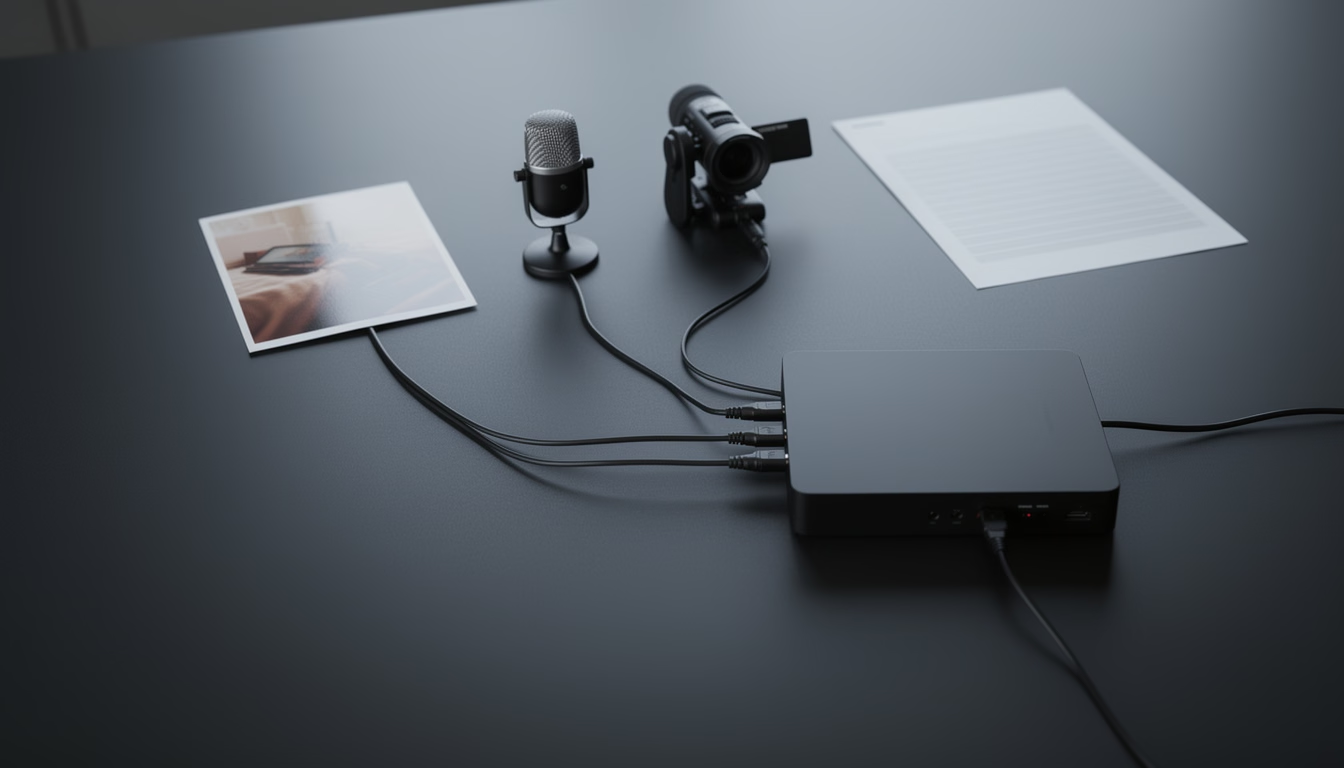
A modality is a type of data. Text is one, an image is another. A model is multimodal when it handles more than one.
OpenAI's documentation starts with images. Recent language models “can process image inputs and analyze them”. OpenAI calls this “a capability known as vision”.
Google makes the broader claim for Gemini. Its models “are built to be multimodal from the ground up”. The documentation says this allows image captioning, classification and visual question answering “without having to train specialized ML models”.
Input and output are separate questions. OpenAI says its GPT Image models “can use text and image inputs to create new images or edit existing ones”. Google's audio guide is narrower: “Gemini can analyze audio input and generate text responses”.
Where the idea comes from
The first step was to bring the transformer to pictures. Alexey Dosovitskiy and co-authors submitted a paper on October 22, 2020. They showed that “a pure transformer applied directly to sequences of image patches can perform very well on image classification tasks”. Our explainer on the transformer covers the architecture: What Is a Transformer? The Architecture Behind LLMs
In February 2021, Alec Radford and co-authors submitted CLIP. The training task was simple: “predicting which caption goes with which image”. The dataset held “400 million (image, text) pairs collected from the internet”.
After training, “natural language is used to reference learned visual concepts”. The authors report that they “match the accuracy of the original ResNet-50 on ImageNet zero-shot without needing to use any of the 1.28 million training examples it was trained on”.
In April 2022, Jean-Baptiste Alayrac and co-authors submitted Flamingo. Its design goals were to “bridge powerful pretrained vision-only and language-only models” and to “handle sequences of arbitrarily interleaved visual and textual data”. It could also “seamlessly ingest images or videos as inputs”.
In December 2023, the Gemini Team at Google submitted the Gemini report. It describes models that work “across image, audio, video, and text understanding”, in Ultra, Pro and Nano sizes.
Two designs
The sources show two ways to build such a model. By its authors' account, Flamingo joins two models that already exist. Google's documentation describes Gemini as built multimodal from the ground up.
How images become tokens
A model reads tokens, not pixels. OpenAI states that “vision models convert image inputs into billable input tokens”. Our explainer on tokens covers the unit: Tokens and Context Windows: What the Numbers Mean
OpenAI describes one method. “Some models tokenize images by covering them with 32px x 32px patches.” The token cost follows from the number of patches.
The API sets hard limits. OpenAI lists up to 1,500 images per request and up to 30,000 patches per image. Images that exceed the patch limit “are rejected, not automatically resized”.
Images also share the budget of the prompt. OpenAI writes that image tokens and the rest of your prompt “must also fit the model's input and context limits”.
How audio is handled
Google gives exact numbers. Audio costs “32 tokens per second of audio (1 minute = 1,920 tokens)”. The maximum length is “9.5 hours of audio per prompt”. The guide adds that “Gemini understands non-speech sounds (birdsong, sirens, etc.)”.
OpenAI shows two architectures for voice. A voice interface for an existing text agent runs “Speech-to-text, the text-agent workflow, then text-to-speech”. The other option is “A speech-to-speech agent using the Realtime session and tool model”.
In the first case, the language model never hears the audio. It only reads a transcript. In the second case, speech is the model's own input and output.
How video is handled
Google documents that “Gemini models can process videos”. By default, video is split into frames sampled at 1 frame per second. Each frame costs 66 tokens at low media resolution and 258 tokens otherwise.
The audio track adds “32 tokens per second”. Google's total: “Approximately 100 tokens per second of video at default (low) media resolution, or approximately 300 tokens per second of video at high media resolution.”
So a 10 minute video at default resolution comes to roughly 60,000 tokens, by this documentation. That is our arithmetic, not a figure Google states.
Google also offers an opt-in agentic mode. The model explores the video and loads only what it needs. Google states that agentic processing “typically uses up to 88% fewer total tokens than static processing for long-form content”. That is Google's own figure.
Where multimodal models fall short
OpenAI opens its list of limits with a plain statement: “Vision models can make mistakes.” Its list includes counting (“The model may give approximate counts for objects in images”) and spatial reasoning. On the second, OpenAI writes that the model “struggles with tasks requiring precise spatial localization, such as identifying chess positions”.
OpenAI also says the model “is not suitable for interpreting specialized medical images like CT scans”.
Anthropic's list is similar. “Claude can give approximate counts of objects in an image but might not always be precisely accurate.” Anthropic adds that Claude “might hallucinate or make mistakes when interpreting low-quality, rotated, or very small images under 200 pixels”.
One limit is specific. Anthropic says: “Claude cannot determine whether an image is AI-generated and might be incorrect if asked.”
The advice is the same in both. Anthropic writes: “Do not use Claude for tasks requiring perfect precision or sensitive image analysis without human oversight.”
How images, text and meaning connect
Multimodal models and embeddings are related. Google's embedding models work for “text, images, video, and other content”. Our explainer on embeddings shows how such vectors are compared: What Are Embeddings and Vector Databases?
What this article does not cover
We did not run any model on an image, a recording or a video. Token figures are vendor documentation as of November 6, 2026, and they change with each model.
We read the abstracts of the four papers, not their full texts. We did not cover image or video generation beyond the one OpenAI statement above. Anthropic's vision guide covers images only, so we make no statement about other Anthropic inputs.
Sources
- OpenAI, Images and vision (API documentation): https://platform.openai.com/docs/guides/images-vision
- OpenAI, Audio and voice (API documentation): https://platform.openai.com/docs/guides/audio
- Google, Image understanding (Gemini API documentation): https://ai.google.dev/gemini-api/docs/image-understanding
- Google, Audio understanding (Gemini API documentation): https://ai.google.dev/gemini-api/docs/audio
- Google, Video understanding (Gemini API documentation): https://ai.google.dev/gemini-api/docs/video-understanding
- Anthropic, Vision (Claude Platform Docs): https://platform.claude.com/docs/en/build-with-claude/vision
- Google, Embeddings (Gemini API documentation): https://ai.google.dev/gemini-api/docs/embeddings
- Dosovitskiy et al., An Image is Worth 16x16 Words: Transformers for Image Recognition at Scale (arXiv:2010.11929): https://arxiv.org/abs/2010.11929
- Radford et al., Learning Transferable Visual Models From Natural Language Supervision (arXiv:2103.00020): https://arxiv.org/abs/2103.00020
- Alayrac et al., Flamingo: a Visual Language Model for Few-Shot Learning (arXiv:2204.14198): https://arxiv.org/abs/2204.14198
- Gemini Team Google, Gemini: A Family of Highly Capable Multimodal Models (arXiv:2312.11805): https://arxiv.org/abs/2312.11805